Arthur Ganate
Journey to the End of the NightArthur Ganate is Ferdinand Bardamu’s friend from medical school and the first person to draw him into the conversation that begins the novel’s action. In their exchange on Place Clichy, Arthur defends conventional ideas about France, its people, and patriotic duty, while Bardamu answers with a bleak account of poverty, inherited subordination, and social misery. Their disagreement acquires immediate consequence when a regiment passes the café: Bardamu enlists, despite Arthur’s attempt to dissuade him. Arthur thus serves both as a conversational foil to Bardamu and as the witness to the abrupt passage from political talk to action.
Identity and Introduction
Arthur is introduced through his friendship with Bardamu, formed at medical school. The opening scene places them together after breakfast on Place Clichy. Arthur wants to talk and proposes moving inside; once seated, he dismisses the café terrace as a place for fools. The pair look out at a nearly empty street in the heat, and their conversation turns from the city and its supposed modernity to France and the meaning of national identity.
Arthur’s importance lies less in a separate biography than in the opinions and choices revealed in this encounter. He enters the narrative as Bardamu’s familiar interlocutor, someone close enough to argue with him directly, but whose political confidence contrasts with Bardamu’s distrust. The scene gives their friendship a dramatic function: Arthur’s assertions prompt Bardamu to make his own outlook explicit.
National Identity and Social Order
Discussing a newspaper article about President Poincaré’s planned visit to a puppy show, Arthur mocks the paper’s claim to defend the French race. Bardamu counters that the race it celebrates does not exist. Arthur insists that it does and calls it the finest in the world; Bardamu instead describes the French people as a collection of impoverished outsiders driven together by hunger, disease, and cold, with nowhere further to go because of the ocean. Their disagreement turns an abstract argument over national pride into a conflict over how the people of France should be understood: as a distinguished inheritance or as the dispossessed and suffering.
Arthur also invokes the forefathers, insisting that they were as good as the present generation and should not be disparaged. Bardamu accepts the comparison only to argue that the generations have remained unchanged in their subjection. He speaks of people as loyal, exploited, and made into soldiers and heroes for others, and calls them the minions of King Misery. Arthur’s appeal to inherited honor therefore meets Bardamu’s account of inherited powerlessness. Their dispute is not simply about whether the past deserves respect; it is about whether continuity represents a virtue or a mechanism by which suffering and obedience persist.
When Arthur replies that love exists, Bardamu dismisses it as an ideal offered within reach of poodles and asserts his dignity. Arthur labels him an anarchist. Bardamu accepts the designation and says he has written a piece of social vengeance called “The Golden Wings,” then recites its image of a pig-like god with golden wings as a figure of mastery. Arthur rejects the piece and declares his support for the established order, adding that he is not interested in politics. The exchange sharpens their contrast: Bardamu frames social life as domination and revolt, whereas Arthur identifies himself with order even while disavowing political engagement.
Patriotism and Enlistment
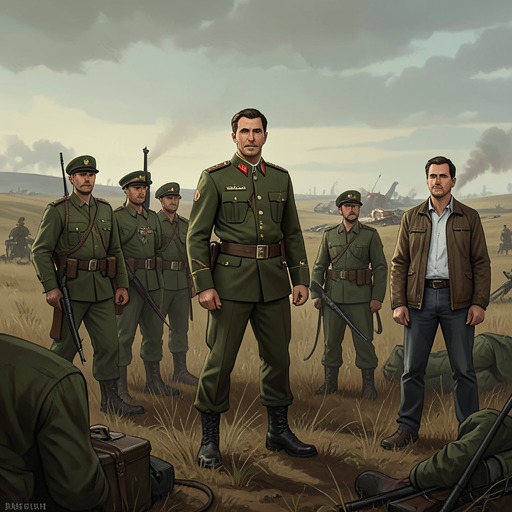
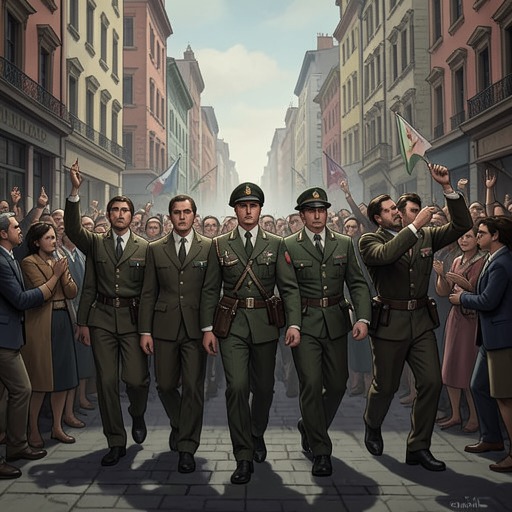
Arthur makes his position most plainly when he says that, should his country ask him to shed his blood, he would be ready and would not shirk. The statement is immediately tested by the arrival of a regiment marching past the café, led by a colonel on horseback. Bardamu rises with enthusiasm and announces that he will go see whether Arthur’s claim is true, then hurries off to enlist. The scene shifts rapidly from argument to deed: a declaration of patriotic willingness becomes the occasion for Bardamu’s enlistment.
Arthur calls after him, warning him not to be foolish. Bardamu is hurt by Arthur’s response and by the effect his apparent heroism has on the surrounding people, but he continues and joins the regiment. Arthur’s intervention does not prevent the enlistment; instead, it marks the point at which their verbal disagreement meets an irreversible choice. Bardamu acts on the patriotic performance before him, while Arthur’s warning underscores the gap between endorsing a principle in conversation and confronting its consequences in practice.
Narrative Role and Significance
Arthur’s opening-scene role is that of a foil whose conventional convictions help bring Bardamu’s outlook into focus. His positions are presented through a sequence of provocations and replies: modern progress, national identity, the forefathers, love, anarchism, established order, and military duty. The discussion does not remain detached exposition, because the passing regiment converts the debate into a consequential encounter and sends Bardamu into military service.
The scene also gives Arthur a limited but decisive role in the novel’s opening turn. He does not enlist alongside Bardamu in the episode; his stated willingness to fight remains a declaration, while Bardamu is the one who acts. The contrast makes Arthur both a friend and a measure against which Bardamu’s impulsive response can be seen. Through their exchange, the novel sets patriotic language beside suspicion of social power, then allows the regiment’s appearance to pull the argument into the events that follow.